By Cecilia Kasperick RN, MSN, CPBN
It happened in 2007. I was receiving report from the day shift RN when she explained pain had been an issue for our patient all day. The team had tried many approaches for pain control, but none had been successful. Therefore, together we were going to implement the newest order: double her PCA dose of medication. We all hoped this would relieve her constant suffering. Unfortunately, that was not the case. As I attempted to fulfill my oncoming RN duties, this patient continually pushed her call button seeking assistance. She was uncomfortable and hoped that repositioning or standing up or going to the bathroom would alleviate her distress. None of these interventions worked, so I paged the doctor. He responded immediately, and when I explained the situation, he was relieved and said, “I was afraid you were paging because you had to push epi.” He knew the PCA dose had been significantly increased a few hours earlier. The doctor informed me they had attempted to control her pain all day, and he was out of ideas. He said he would order a pain consult for the morning, but for now, “Try to make her comfortable.” Try to make her comfortable? It wasn’t even 10 PM. This looked like it was going to be a long night.
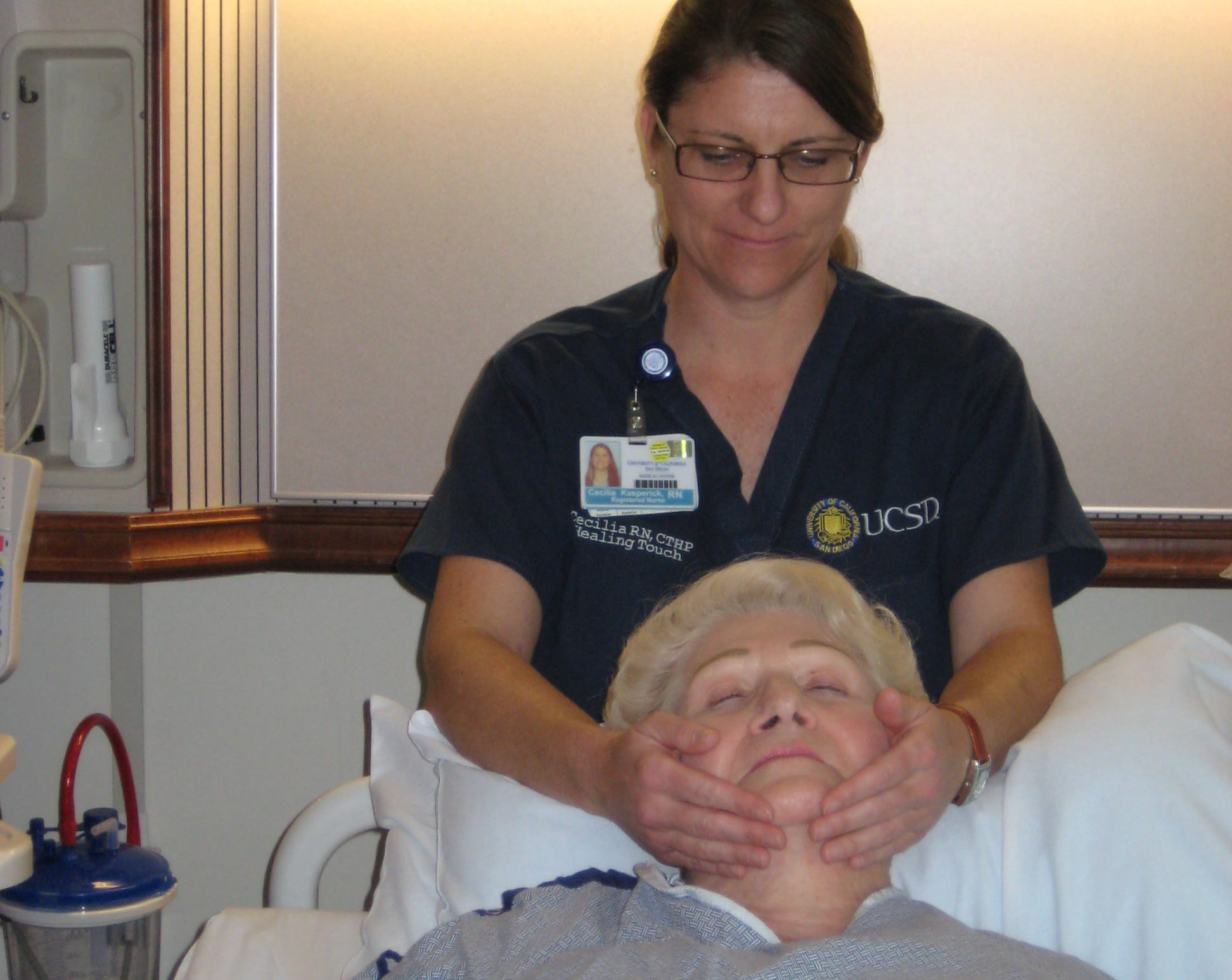
I decided there was nothing to lose by introducing this patient to a complementary modality called Healing Touch. I had just taken a weekend course, where I learned the basic techniques of this energy therapy. I was not confident about the intervention, and felt awkward and self-conscience about presenting the idea; however, my patient was suffering and I had a sincere desire to help. When I shared the idea with my patient she was eager to give it a try, and so I began. She fell asleep while I provided the treatment and she slept for four hours. When I went in to take her vital signs she thanked me profusely. She said Healing Touch had helped her immensely, and she implored me to keep studying this modality saying, “Patients need this in the hospital,” and then she went back to sleep. To be honest, I was shocked to hear the feedback. I never expected it to be this effective, but it was! This experience increased my interest in Healing Touch, prompted additional training in this modality, led to co-authoring a UC San Diego Medical Center Nursing Protocol for Healing Touch, and inspired a desire to train other UCSD nurses in this unique intervention.
Healing Beyond Borders, a non-profit education and certification organization, defines Healing Touch as a relaxing, nurturing energy therapy, in which gentle touch assists in balancing the recipient’s physical, mental, emotional, and spiritual well-being. Healing Touch works with the human energy field to support the body’s natural ability to heal, and it works in harmony with standard medical care. Healing Touch International founder, Janet Mentgen RN, established the Healing Touch curriculum in 1996. It is taught in universities, medical schools, nursing schools, and holistic academies internationally. It is endorsed by the American Holistic Nurses Association (AHNA) and is an intervention that is approved by NANDA International Inc.
Healing is defined as the movement toward wholeness, including body, mind emotion and spirit.
Healing Touch is based on a heart-centered, caring relationship in which the practitioner and client come together energetically to facilitate the client’s health and healing. Patients receive Healing Touch fully clothed and may be seated or lying in bed. Healing Touch practitioners gently place their hands on or slightly above the client. People frequently report feeling deeply relaxed and peaceful during and after the session. These non-invasive techniques utilize the hands to clear, energize and balance the human and environmental energy fields, thereby facilitating the client’s self-healing process. Healing is defined as the movement toward wholeness, including body, mind emotion and spirit. This differs from curing, which strives to overcome an illness or disease. Healing Touch works synergistically with traditional western medicine, and is not intended to replace conventional treatment regimens. Individual responses will vary to this intervention, but research has shown Healing Touch to effectively reduce stress, calm anxiety and depression, decrease pain, strengthen the immune system, enhance recovery from surgery, deepen spiritual connections, support cancer care, create a sense of well-being, and ease acute and chronic conditions (Healing Beyond Borders website).
While serving as a nurse on Thornton 2 East Progressive Care Unit (PCU), I used a Likert Scale to assess patients’ responses to Healing Touch (HT). Before and after receiving the intervention, patients were asked to rate their level of pain and state of relaxation using a scale of one to ten. 100% of patients reported increased relaxation after the treatment. Regarding pain reduction, a paired-sample t-test found the significance level to be p<0.000, meaning that the difference was very significant. Average pain scores (N=35) decreased from 6.61 to 1.79, enough of a difference to deduce the difference was not due to chance or another reason, but that HT influenced the decrease in pain scores. Furthermore, 19 of the 36 patients (53%) of the population had pain scores of seven or greater before HT. After HT only two of the 36 patients had pain scores of seven or greater (6%). Also, before HT seven of the 36 patients (19%) reported a pain score equal to or less than four; and after HT this number increased to 30 of the 36 patients (83%) claiming their pain scores were four or lower. While HT was being offered on 2 East the unit received an award for nursing excellence and impressive Press Ganey scores were consistently maintained.
The successful integration of Healing Touch on 2 East would not have been possible without the support and encouragement of the nurse manager, Kathy Ryan RN. She endorsed education on the modality at staff meetings, and gave nurses, clinical care partners (CCPs) and ancillary staff the opportunity to experience treatments. During Nurse Week 2008 a “Healing Touch Day” was offered and staff members were encouraged to receive treatments. Before and after Healing Touch, 36 staff members were asked to complete a Likert scale survey to assess their level of pain, stress and general well-being. In all of these areas Healing Touch revealed statistical significance (p<0.05). Average pre-Healing Touch pain score of 2.67 decreased to 0.81 post Healing Touch; pre-Healing Touch average stress scores of 5.69 decreased to 1.50 post Healing Touch; and pre-Healing Touch average well-being scores of 6.46 increased to 8.71 post Healing Touch.
The results of this study highlight the well-known fact that nurses and bedside staff have a tremendously difficult job. The term compassion fatigue, defined as a unique form of burnout, resulting from helping or desiring to help suffering persons, (Joinson 1992, Figley 1996), is now common place in healthcare settings. Healing Touch could be a powerful intervention to counter this trend. In addition, I have found that providing Healing Touch has a similar effect, decreasing my own stress and increasing my sense of well-being.
Having time to care for a patient, focusing 100% on their welfare and highest good, aside from medications to be passed, hourly rounds to be made, call lights to be answered, GRASP (patient acuity) and detailed charting to be completed, can be incredibly healing. Healing Touch treatments must be given from a place of unconditional love and service. These are qualities valued by most healthcare workers, yet are too often extinguished by the overwhelming demands and responsibilities of direct patient care. Most professionals enter healthcare with a desire to help people and alleviate suffering. Healing Touch provides a venue to fulfill this calling. Both giving and receiving Healing Touch has renewed my passion for nursing, and I consider treatments an important dimension of my self-care.
Florence Nightingale said, “Healing is placing the patient in the best possible condition for nature to act upon him.” I believe Healing Touch does this! Patients consistently have a positive response to this intervention, and their gratitude is what has motivated me to continue studying Healing Touch and to eventually become an instructor for Healing Beyond Borders. As an instructor, I feel I am making a meaningful contribution to the profession of nursing and to UCSD Health System. In the last 18 months, 40 UCSD employees have been trained in level 1 Healing Touch techniques. I hope that interest in this modality will continue to rise and that one day Healing Touch and other integrative modalities will be a standard of care for all patients.
If you are interested in attending a Healing Touch class, please contact Nursing Education and Research at:
https://health.ucsd.edu/medinfo/nursing/edr/about/Pages/contact.aspx
UCSD Healing Touch Nursing Protocol can be seen at:
http://medcenter.ucsd.edu/edr/resources/Nursing%20Resource%20Library/Healing%20Touch%20Protocol.pdf

ABOUT THE AUTHOR
ABOUT THE AUTHOR
Cecilia Kasperick RN, MSN, CPBN has been working with UC San Diego Health System since 2009. She received her master’s degree in Clinical Nurse Leadership & Education from the University of San Diego and has worked with inpatient critical care and outpatient oncology. Cecilia is a Certified Healing Touch Practitioner, and Level One Healing Touch Instructor. She is a member of the UCSD Holistic Integrative Nursing Committee, Healing Beyond Borders, American Holistic Nursing Association and the Oncology Nurse Society.
Healing Touch: One Patient's Perspective
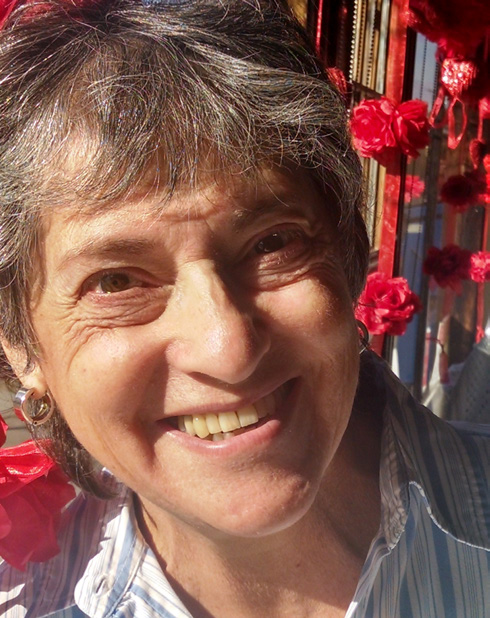
By Nikki Schweitzer
I have been a Healing Touch practitioner for many years but mostly in name only, even though I have personally facilitated, and experienced, its benefits. When I received an unexpected diagnosis of early breast cancer on January 15, 2014, I knew that, in addition to the wonderful allopathic medical care I would receive at UC San Diego, I also wanted to receive Healing Touch and its benefits.
The night before surgery I e-mailed Lori Johnson RN for help. Even though she was out of town she quickly responded with a promise to coordinate a Healing Touch treatment for me; and a half an hour before my surgery, Cecilia Kasperick RN, Moore's Cancer Center Patient Navigator, let me know that she was on her way!!
My surgeon, Dr. Blair, met with Cecilia and we were good to go. At my bedside Cecelia played relaxing music as she calmed my body and my spirit. She was able to reduce my anxiety, relax my muscles, and put me in the best physical and emotional state I could be in for my surgery. My husband and son, who watched, told me they were able to see the positive effects the treatment had for me.
I could write pages and pages about my experience, but what is most important is that, in addition to the incredible care and compassion I had from the nurses and doctors all through this journey, while I waited for my surgery I was able to experience the personal connection, relaxation, warmth, and security that comes from Healing Touch.
The surgery went off without a hitch. My cancer is all gone!! The next day, I went for an acupuncture treatment and then took my husband out to celebrate his birthday in Balboa Park and I haven't slowed down much since!!